

The Middle East has always been a region of contrasts — ancient trade routes threading between modern skylines, timeless hospitality co-existing alongside complex geopolitics. In an era where the ongoing Iran-Israel conflict has cast a long shadow over regional air travel, more and more travellers are rethinking how they move between cities. For anyone planning a trip from Dubai to Muscat, the overland bus route is not merely a budget alternative — it is, for many, the smartest and most dependable choice available.
This comprehensive guide, brought to you by Gulf Visa Services, walks you through everything you need to know about making this journey by road: the operators, the border procedures, the practical tips, and the broader context that makes this route increasingly relevant in today’s geopolitical landscape.
Since the escalation of hostilities between Iran and Israel — a conflict that has drawn in proxy forces across Lebanon, Syria, Iraq, and Yemen, with tremors felt across the wider Gulf — regional aviation has been subjected to extraordinary pressures. Airlines have repeatedly suspended routes, rerouted long-haul flights to avoid contested airspace, and issued passenger advisories that change by the week. Airports in the northern Gulf have experienced intermittent disruptions, and travellers relying solely on air connections have found themselves stranded, facing inflated ticket prices, or scrambling for last-minute alternatives.
Oman, for its part, has maintained a notably neutral foreign policy posture throughout the conflict. Muscat continues to serve as a quiet diplomatic hub — a role the Sultanate has historically embraced with skill and consistency. This neutrality makes the Dubai-to-Muscat overland corridor one of the most stable travel arteries in the broader region. The road remains open, border procedures function normally, and the route offers the kind of predictability that air travel in a conflict-adjacent region simply cannot guarantee right now.
Gulf Visa Services Advisory: Always verify the visa requirements for both the UAE and Oman before committing to an overland crossing. Transit and entry rules can shift during periods of regional tension. Our team is available 24/7 to assist.
The overland journey from Dubai to Muscat covers approximately 440 kilometres and typically passes through the Al Wajajah / Khatmat Malahah border post, which connects the UAE’s eastern corridor with Oman’s Al Batinah region before continuing southward to the capital. An alternative routing via the Hatta border crossing is available for travellers departing from Dubai’s inland enclave, though the Khatmat Malahah crossing is generally preferred for its efficiency and the quality of its facilities.
Under normal conditions, the total travel time — including border processing — ranges between five and seven hours, though travellers should budget additional time during holiday seasons, Friday evenings, or periods when border authorities apply enhanced screening measures. During heightened regional tension stemming from the Iran-Israel conflict, it is not unusual for crossing procedures to be more thorough. Patience and preparation are your greatest assets.
Several reputable operators run scheduled services along the Dubai-Muscat corridor. Here is what you need to know about the primary options:
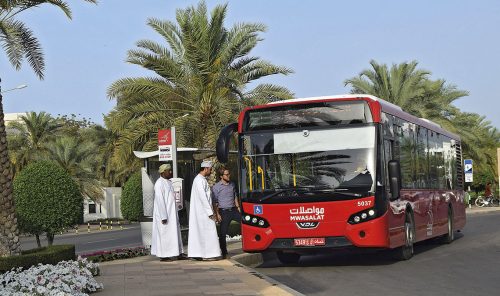
ONTC is the flagship state-backed operator and the gold standard for this route. Buses depart from the Al Ghubaiba Bus Station in Bur Dubai. Coaches are fully air-conditioned, equipped with reclining seats and luggage storage, and staffed by professional drivers with extensive experience navigating border protocols. ONTC runs multiple daily services, with fares ranging from approximately AED 60 to AED 90 depending on service class and time of booking. Advance reservation is strongly recommended, particularly during periods of elevated regional tension when demand for overland travel spikes.
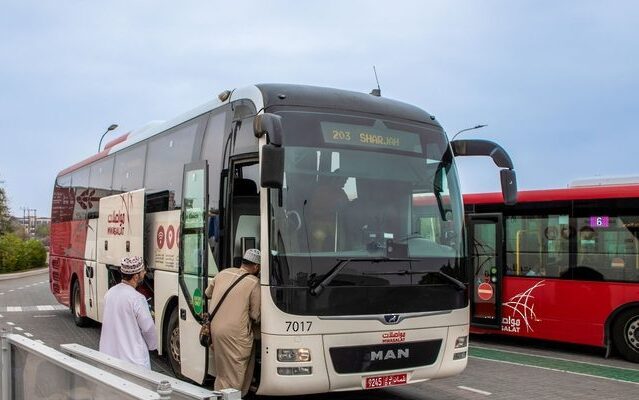
Mwasalat is Oman’s national public transport authority and operates services connecting Muscat with the UAE. While its schedules on this corridor are typically less frequent than ONTC, its coaches are modern and comfortable. Mwasalat buses arrive at and depart from the Ruwi Bus Station in Muscat, which is a short taxi or ride-hailing trip from Muscat International Airport.
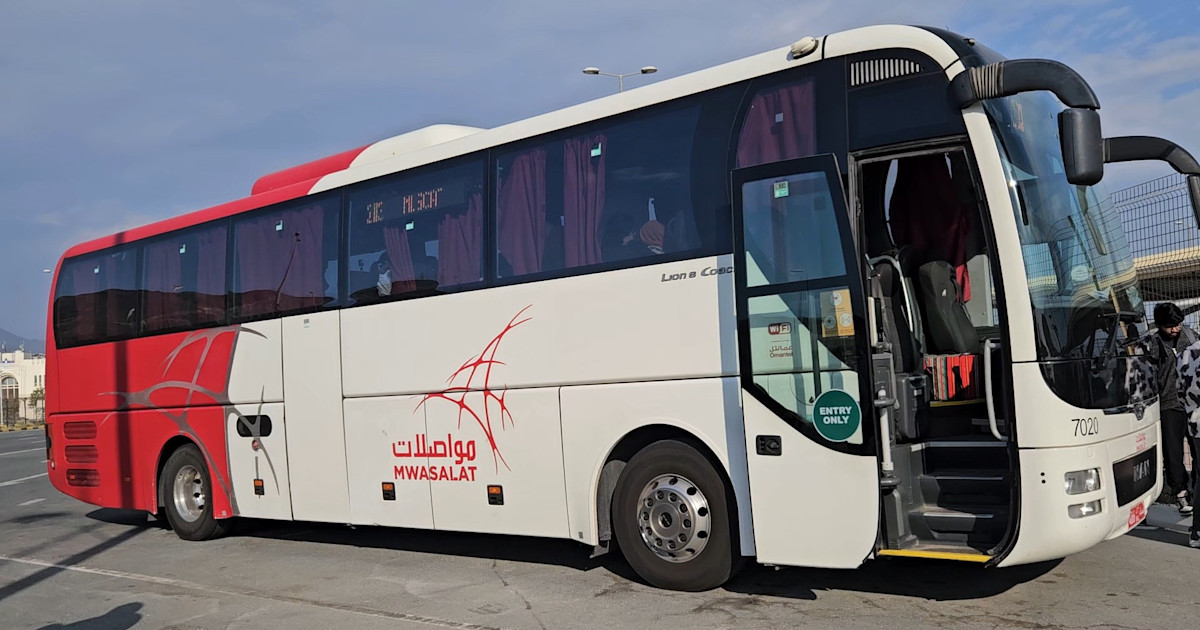
Mwasalat is Oman’s national public transport authority and operates services connecting Muscat with the UAE. While its schedules on this corridor are typically less frequent than ONTC, its coaches are modern and comfortable. Mwasalat buses arrive at and depart from the Ruwi Bus Station in Muscat, which is a short taxi or ride-hailing trip from Muscat International Airport.
For many travellers, the border crossing is the most daunting element of the journey. In reality, with the right preparation, it is a smooth and entirely manageable experience. Here is what to expect:
Pro Tip from Gulf Visa Services: Apply for your Oman e-Visa at least 72 hours before travel. During periods of heightened regional security activity related to the Iran-Israel conflict, processing times at immigration systems can extend. Our team can expedite your application.
If your ultimate destination is Muscat International Airport — officially Sultan Qaboos International Airport (MCT) — rather than the city centre, you have several straightforward options upon arriving at Ruwi Bus Station or the ONTC terminal.
The Dubai-to-Muscat bus journey rewards those who prepare thoughtfully. A few essentials to have in order before you board:
While the Dubai-Muscat overland route remains among the most insulated travel corridors from the direct effects of the Iran-Israel conflict, prudent travellers stay informed. Here is what to monitor before and during your journey:
Gulf Visa Services provides real-time visa status updates and regional travel advisories for the UAE-Oman corridor. Register on our platform to receive timely notifications relevant to your specific travel dates and nationality.
There is a certain wisdom in the overland route that experienced travellers in this part of the world have long recognised. Roads are harder to close than airspace. Bus schedules are less volatile than airline timetables during geopolitical stress. And the journey itself — sweeping through the dramatic Hajar Mountain passes, the ancient date-palm wadis of Oman's interior highlands, and the luminous coastal plains approaching Muscat — offers a profound sense of place that no airport terminal can replicate.
In a region currently navigating one of its most complex geopolitical periods in recent memory, the Dubai-to-Muscat bus route stands as a quiet testament to something enduring. The ancient incense road between the Arabian Peninsula's great trading cities has always found a way to stay open. Commerce, connection, and human movement have outlasted every previous conflict in this region's history. They will outlast this one too.
At Gulf Visa Services, we specialise in making cross-border travel between the UAE and Oman as seamless and stress-free as possible — particularly in complex and rapidly changing regional environments. Our services include:
Whether you are a first-time visitor navigating the crossing independently, a business traveller seeking a dependable alternative to cancelled flights, or a family planning an overland journey through two of the Gulf’s most welcoming nations, Gulf Visa Services is your trusted partner for every kilometre of the road ahead.